
JPMorgan is working on AI agent transactions that donât involve humans
The J.P. Morgan logo sign is seen in New York City, United States, on August 6, 2026. JPMorgan Chase & Co. is a leading American global financial services firm and the largest bank in the United States. (Photo by Marcin Golba/NurPhoto via Getty Images)
Nurphoto | Nurphoto | Getty Images
Artificial intelligence agents have already proven to be helpful, or cause a lot of trouble, or both. One area seen as high-potential is in payments, where â if they’re able to be trusted â the agents could deal with all sorts of money matters on behalf of people.
That’s why JPMorgan Chase and South Korea’s Hyundai Card are testing how AI agents can handle financial transactions without direct human intervention, including whether they can eventually negotiate and make payments with one another.
The companies have completed an initial proof-of-concept involving a simulated foreign exchange transaction and are targeting the first half of 2027 for a more complex phase involving multiple AI agents.
What happens when agents are negotiating, agreeing directly with each other and then making payments? What does that actually look like?
Wee Kee Toh
Global Head, Kinexys Insights
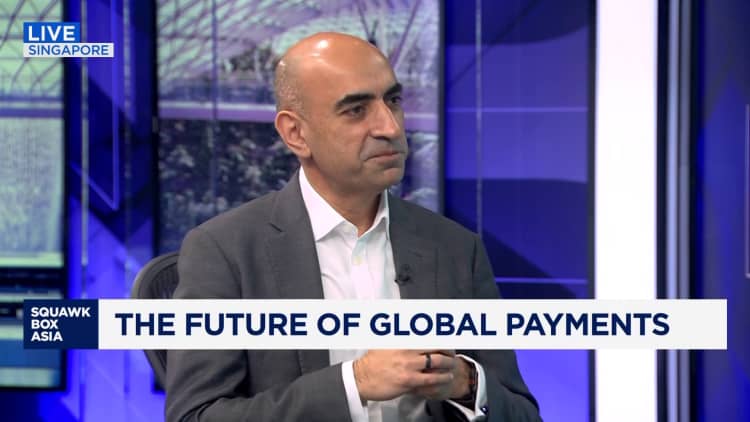
Wee Kee Toh, global head of Kinexys Insights at Kinexys by JP Morgan, told CNBC that the next step is to test what happens when autonomous agents move beyond execution and begin interacting with each other in an ecosystem.
“That, I would say, is really the biggest part of what we want to get as an expansion of the phase one scope,” he added.
The initial trial involved a Hyundai Card AI agent requesting a foreign exchange transaction to maintain euro liquidity in its Kinexys blockchain deposit account. JPMorgan said it was the first private blockchain-based autonomous bank-agent-to-client-agent test for corporate treasury management.
The accountability question
While the initial trial has been completed, JPMorgan has yet to set a timeline for commercializing the technology.
Toh said building the technology itself was relatively straightforward, but establishing appropriate governance and internal controls proved more difficult.
“Technology-wise, it’s really not the biggest hurdle,” he said, pointing instead to questions around accountability and the risks of allowing AI agents to execute financial transactions without direct human oversight.
However, the potential of such agents to change interactions with financial services has to come with equivalent accountability, according to experts.
Data management and protection software company AvePoint found in its State of AI 2026 report that unauthorized autonomous agent actions were the third most common AI agent-related security breach, affecting 34.1% of companies that reported such incidents.
Those actions included executing transaction and modifying data without approval, though the findings were not isolated to corporate treasury payments.
“When agents negotiate and execute autonomously ⦠governance shifts from monitoring human behavior to monitoring machine-to-machine dependencies,” said AvePoint CEO Tianyi Jiang.
Jiang explained that interacting AI agents could amplify errors and trigger transactions before humans can intervene.
âThe worst-case scenario is a cascading failure where one compromised or hallucinating agent feeds bad data to another,â he said, potentially âtriggering a high-speed chain reaction of flawed financial transfers before a human even realizes it is happening.â
To address such concerns, Kinexys developed a framework that restricts AI agents to predefined transaction parameters, automatically rejecting requests that fall outside authorized limits.
“You are going to draw a box around the agent. The agent will never be able to do anything out of the box,” Toh said.
For example, an AI agent authorized to transact up to $5 million would be blocked from executing transactions above that threshold, he said.
Hassan Ahmed, Coinbase’s Singapore country director, said safe agentic payments will require clear guardrails, including spending limits, restricted account permissions and explicit authorization requirements.
Users should also be able to monitor activity and revoke access at any time, he said, given the potential for AI to create new opportunities for malicious actors.
“While private or permissioned environments may offer additional controls for certain use cases, we should not lose sight of the potential of open blockchain networks to support more accessible, interoperable and efficient financial systems,” Ahmed said.
Beyond the pilot
JPMorgan and Hyundai Card are also exploring whether to extend their collaboration to other businesses within Hyundai Motor Group, whose broader operations were one reason the bank selected the credit card company as a partner, Toh said. No specific projects have been announced.
Hyundai Motor Group holds a combined 78.04% stake in Hyundai Card through Hyundai Motor, Kia and Hyundai Commercial, according to the card issuer’s website.
Hyundai Card has previously experimented with blockchain-based cross-border payments. In July, the company said it completed a proof-of-concept involving a $20,000 transfer using the USDT stablecoin between Hyundai Motor’s U.S. and Mexican subsidiaries, with the transfer and verification process taking an average of seven minutes.
Kinexys has also been expanding its blockchain-based payments business. The JPMorgan unit said in August that it had processed more than $4 trillion in transactions since inception, averaging about $7 billion a day.
Separately, JPMorgan launched a proof-of-concept for its dollar-denominated deposit token, JPMD, in June 2025, before making it available to institutional clients that November.


